Friday, June 26, 2015

Texel May 2015

Hi,

 still too long between posts, and I am afraid this blog will never take off.


Anyway, I have been in Texel at the end of May, three days hoping for the same good weather I got in April, and more birds. Neither of the two, unfortunately. Weather was not bad, but I did not get the super light I was lucky enough to get in April. Three days: half sunrise and zero sunsets.

Texel is still the place to go for bird photography in the Netherlands, but the dynamics of the island changed in the past two years.

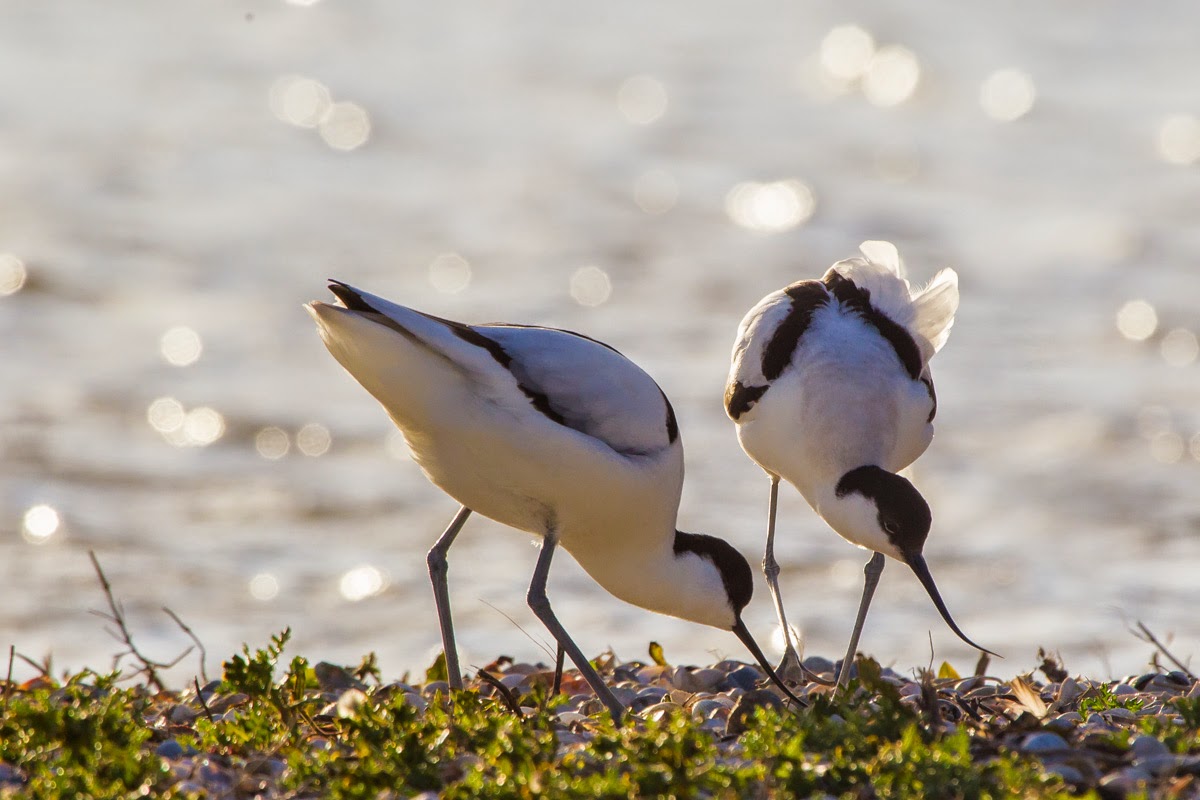
The wagejot is not the incredible photography site that it was, since avocets and terns do not nest anymore in the small shells-island few meters off the banks where it is possible to stay for photos. Avocets will still pass pretty close but not as frequently. Terns are nesting far away so basically there are none at photo-distance.


Nearby Wagejot there's another location which is interesting: Ottersaat. It's a nesting site for terns, mostly and avocets, the nests are not very close (interesting photos can be taken with a 700-900mm equivalent lens) but it's very nice to take in fly photos of terns, and also avocets. I spent few hours both mornings trying to do my best with flying birds.


Waalenburg is as always good locations for godwits.


In the south, this year a couple of bluethroats, male and female, nested very close to the road (Molkweg) so I spent half of my time in Texel, sitting in the area taking picture of them going back and forth to feed their offspring.


The south of the island is interesting also for flying spoonbills, who in the evening can be spot as they go back to their nests. Mind you, it's not like there are flocks of spoonbills flying back and forth over you :) But if you want to see and phograph them I would suggest to go there around 4pm and stay at least for a couple of hours, probably you will see two or three groups of spoonbills flying to their nests. There are two observation points, a little bit above-ground where it may be easier to see the birds. I personally took some photos while waiting for the bluethroat.


End of May is also a very good moment for the wild orchids, I have seen *a lot* of them while driving around De Staart for the godwits, unfortunately in protected areas. I found some nearby the road just south of the Airport, on the left side (going south). If you find them, please be very careful not to damage neither them nor the area around them.


As always, I had a lot of fun in Texel but a little more luck with the weather and the birds would have made it even better. Two years ago the situation was better, more birds and closer. Nature changes continuously, therefore it is foolish to think that animal habits would stay the same between years. But I hoped it, I must admit :-)


For my future trips there, I really want to go for a boat-trip to visit the seals colonies, during a low tide, again this year I was not lucky, the only trip feasible for me was sold out :(

As always, comments and questions are welcome.

Regards
 Peter

Wednesday, April 15, 2015

Godwits are back!


This is just an heads-up.
Bar-tailed godwits are back, and they have been back for a while now. From the end of March, I would say.
I met them in Texel, but - of course - the primary place for the Amsterdam-based photographers is the Arkenheem Polder meadows area just south of the Flevopolder in Gelderland. If you visit the area by car, please, make sure you are only using the car in the roads where it is allowed, if you need contact me for more information.
Godwits will not stay there forever, already after the end of May they'll move in other areas. I will follow them, for example in the Groene Jonker, as every year. But Arkenheem is worth a visit if you are around, for example for the photographers who travel to the Netherlands to visit Texel in these days, the polder could be a nice chance to fill-up the memory cards.

As usual, comments & questions are welcome.
Thanks for reading.


Saturday, April 11, 2015

Scouting in Texel


It has been a while since I wrote a blog post. Winter passed with very little photography, due to lack of luck and lack of time to focus on photography.

Anyway, in the Easter week-end I spent two days in Texel, I am sure that every bird photography enthusiast knows this beautiful island. Texel is the biggest of the frisian islands, the most populated and the easiest to reach by ferry, only 20 minutes from Den Helder. And it is the bird photographer paradise of the Netherlands. 

It is famous for the avocets, spoonbills, singing birds, terns and other migratory birds and seals. The best period to visit the island, if you're looking for photos, is Second half of April, and end of May beginning of June. Being the beginning of April I did not go with the only objective of taking photos, but also to spend a couple of days walking on the beaches, and in the polders of the island. 

But, focusing on the birds, some considerations:
The Wagejot was already full of avocets very active and friendly as usual.
I could not see almost any tern on the island, not at the Wagejot neither in Den Helder where they usually go fishing.

No birds of prey either. This was strange, one thing is not being able to take good pictures of them, but two days on Texel without seeing any bird of prey.. it's weird. I really hope to see more next time.
The godwits are quite active already, but for them there are better places in the Netherlands, I hope I will be able to write a post in one month or so.
Not many singing birds, for the moment, the dunes were silent.
I've seen one spoonbill, but no photos taken.

I spent a couple of hours at the Wagejot at sunset and sunrise. And I had fun filling a 16GB memory card.

In a cloudy and almost rainy afternoon I walked on the dunes leaving the car on the Zanddijk mostly to walk on the dunes, but I had a chance to see some oystercatchers and sandpipers.
The evening I enjoyed some backlight at the Wagejot pond.


But I was already planning an early awake, not even really early since my hotel was 5 minutes from the Wagejot, and the sunrise was 7:08am, how convenient! Anyway, morning light is really beautiful at the Wagejot, if you go few days at Texel, make sure you'll spend at least one sunrise with clear sky there.


This was only an exploration/scouting trip, I will be back in Texel at the end of May, I really look forward to it, and I hope I will have more to write!


As usual comments and questions are welcome.

Thank you for reading.

All photos taken with Canon EOS 1D Mark IV and Sigma 500mm F4.5 EX DG with the teleconverter Kenko GDX pro 300 1.4.

More resources on Texel:

Wednesday, October 22, 2014

Unexpected rutting

Saturday was the last warm day of 2014, based on what weather forecast were telling us. And actually was quite pleasant, this week temperatures dropped of about 10 degrees.

So I decided to take the camera after almost a month and go somewhere to take pictures, and I decided for the Zuidpier (south pier) where on the shore it is possible to find diverse species of sandpipers and, being lucky also snow buntings and other interesting birds. I usually go in March but I decided to give it a try anyway. I took my beanbag and an old pan with me.

The main difference is that now sunrise is around 8am, and in March is around 6am, convenient one would say.. no it isn't convenient the beach had people walking scaring birds away right after the sunrise, hard to make birds come close.

A lot of seagulls and only one remarkable subject, in my opinion, one Bar-tailed Godwit, shouldering his way across the gulls. Laying on the sand, with the pan supporting the beanbag on the sand, I managed to get closer to the bird, little by little, making the pan (with the beanbag and the lens on the beanbag) sliding 30cm every time. I wasn't very close though, and the following pictures are consistent crops of the frame.


He decided to walk away from me to look for nutrients in the sand, so I stayed put waiting for him to come back. 

It did not happen.

Two ladies were walking something like 6-8 dogs on the shore and they scared away the bird. A pity, but ok. I couldn't find him anymore and there were no other interesting subjects for me, no buntings either on the dunes. It was half past nine, anyway, I did not want to go back to Amsterdam yet. So, I headed to the AWD north entrance to see if I was lucky enough to see some foxes. 

I wasn't, but the fallow deer were still in the rutting period, which was kind of unexpected, I knew they were rutting, but I thought it was over, since the season started very early for red deer this year. Not expecting fallow deer being so active I did not pass through the most populated areas, but still I was able to get some pictures of some activity.


A male belling his call to attract females and challenge other males. Also this one is a good crop.


Another male running after a female, in the foreground, who was clearly not much convinced of his belling :-D

To testify the impressively warm year we are having in the Netherlands, the dunes were still really full of dragonflies, most of them flying in couples. No pictures, sorry, I'm very bad with macro photography :-(

Now the rutting season should be really over.. and we are entering the second part of Autumn with no much photography chances. I  will try to look for birds of prey next month.. I will post about it if I have any success.

All photos taken with a Canon EOS 1D Mark IV and a Sigma 500mm F4.5 EX DG.
As usual, feel free to contact me for questions.

Thanks for reading.
 Peter

Saturday, October 4, 2014

The rutting season at the Hoge Veluwe

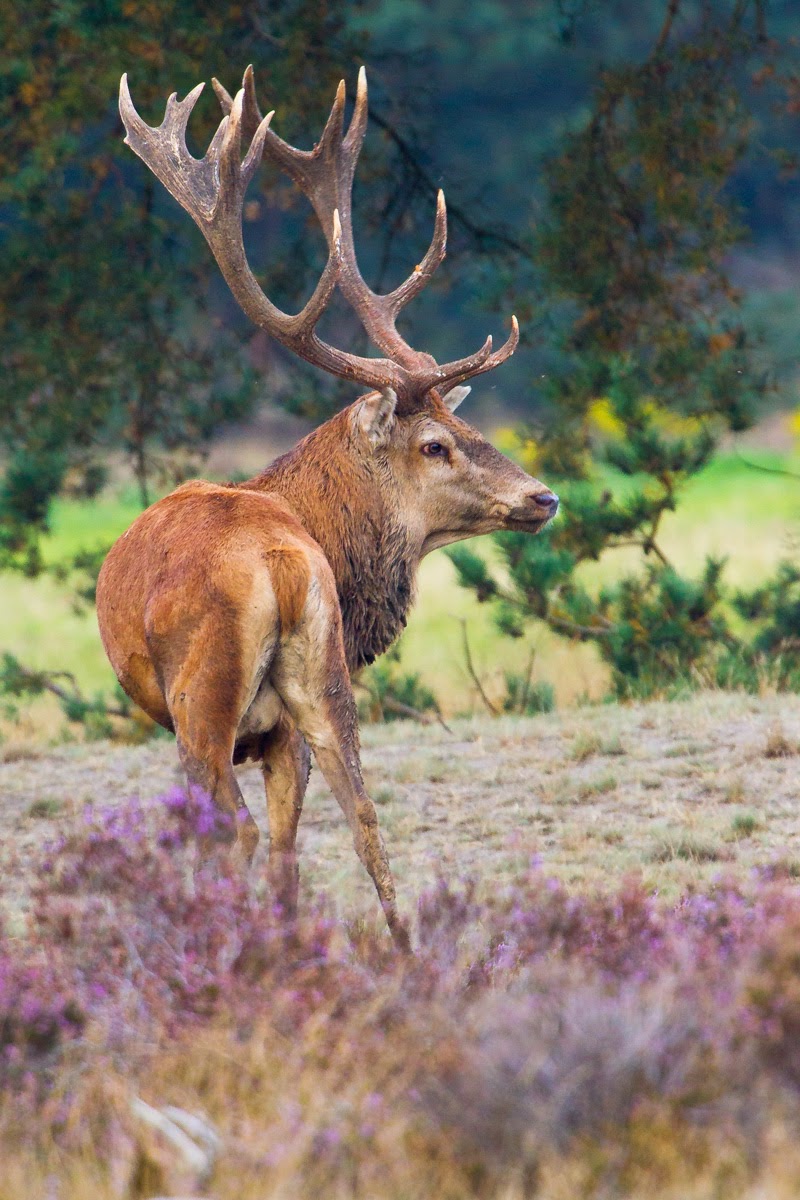
September is the rutting season for the red deer at the Hoge Veluwe national park.
The rutting season is the mating season for the big mammals, male deer usually don't hang around with the hinds, but during the beginning of autumn the mating instinct pushes them to stay with the herd, it's therefore easier to see the males.

The most famous place in the Netherlands to enjoy this activity is the national park Hoge Veluwe, where there are at least three big herds of deer. The rangers and park administration know that this is a great added value for the park and a big opportunity of income to sustain the park itself.
To make more attractive for photographers, during September (only September!) the rangers feed the deer with apples to attract them in front of specific observation points.


There are two feeding points relatively close, one or two hundreds meters apart, on the road called Wildbaanweg. Usually the rangers distribute food first on the point more souther, than on the north one. I suggest to stick with the north one, since it's likely that the animals stay around longer, not being bailed anymore after that feeding.

If you enter from the north west entrance drive until where you have to turn right to go towards the museum, then you should go straight on until you see photographers :)
In september there are a lot of them.

The rutting season begin can change from year to year, this year (2014) started very early, at the end of August, last year on September 10th was everything quiet. I think that if you have only one day in September, a safe bet is around September 20th, at that point the rutting should be in full swing.

And you can see male and females together, point your cameras to the males and wait for them to shout their love call!


The deer will hang around for around 15 minutes or more, so be ready to shoot as many pictures as you can, check your settings when you see the ranger spreading apples, it will takes few minutes for the deer to arrive. 

Stay on that spot until you're happy with your photos, or the deer go away. I usually stay there a little longer to try to get deer from different point of views.
Eventually these beautiful animals will leave, and disappear in the woods.


Then, you can go home, or.. if time allows.. continue south on the road and go to another observation point, just after a crossing but on the same road. You'll see, if you're lucky, other photographers. At this point there are chances to see deer from a smaller herd, but being the area on the west of the road you will get some photos with a different light, this year I was not lucky this year, but it's worth trying!

Now it's probably too late for the Hoge Veluwe, but the rutting season at the Oostervaardersplassen is shifted few days later, so you may have luck there, or try the AWD for the rutting season of the fallow deer, that usually goes well into October. 

All the photos were shot with a Canon EOS 1D Mark IV and a Sigma 500 F4.5 EX DG (sometimes multiplied with a Kenko 1.4x).

Hope you found this post interesting, please feel free to contact me for any question!


 Peter